Rainbows Day 3 -Color Wheel

For the third day of our Rainbow Unit Study we learned that the rainbow colors make up the artist’s color wheel.  We learned about primary colors, secondary colors, and complementary colors.  We did some color mixing science and made some more yummy rainbow snacks. I also introduced a fun sensory tub today.

The Color Wheel

Discuss:

Primary Color- Red, yellow and blue. Primary colors are the 3 colors that can not be mixed or formed by any combination of other colors. All other colors are made from these 3 hues.

Secondary Colors- Green, orange and purple. These are the colors formed by mixing the primary colors.

Complementary colors- are any two colors which are directly opposite each other on the color wheel, such as red and green and red-purple and yellow-green. 

ReadTake a Walk on a Rainbow by Miriam Moss

Comprehension Questions:

  1. What are the primary colors? Red, Yellow, Blue
  2. What are the secondary colors? Green, Orange, Purple
  3. How can you easily find complementary colors on the color wheel? The are opposite each other.

Painting A Color Wheel

I printed off this Color Wheel and let the children paint it with the colors in the correct order.

Color Mixing

Discuss: Ask your child if he has ever heard the word “hypothesis” before. Explain that “hypothesis” is a special word that scientists use for “an idea that you can test.” A hypothesis is a kind of prediction. Explain that when someone makes a hypothesis, he or she uses clues to make a guess about something. Give some examples, such as, “If I drop this basketball on the floor, my hypothesis is that it will bounce.” Or, “When I see dark clouds in the sky, I have a hypothesis that it will rain soon.” Encourage your child to come up with a simple hypothesis or two.  How can we test your hypothesis?

Show a color wheel to look at and discuss. What are the primary colors (red, yellow, blue). Ask them what there hypothesis is about mixing red and yellow? It will make orange. What about yellow and blue? It will make green. What about red and blue? It will make purple.

Materials:

  • White ice cube tray
  • water
  • red, yellow, and blue food coloring
  • 6 clear jars
  • Eye dropper

Directions:

  1. Fill the ice cube tray with water.
  2. Add 1 drop of one color to each section (make some red, yellow, and blue). 
  3. Put it in the freezer at least an hour before the activity.
  4. Fill 6 clear cups with water. Add the red, yellow, and blue food coloring to the cups, one color per cup.
  5. Do you think we can make all the colors of the rainbow with only these three primary colors.
  6. Take out the ice cubes and let them know that they are the same 3 colors that are in the cups, the primary colors.
  7. What do you think will happen if we put a red ice cube into a yellow cup?
  8. Drop it in, then stir. Orange!
  9. What do you think will happen if we added blue to yellow? Green!
  10. Next try red and blue, which makes the purple.
  11. Then the kids will want to see what would happen when we mixed all the colors and make brown.
  12. Line up the colors in order and said.. We made all the colors of the rainbow!

Extension:

  1. Use the red, yellow, and blue cup of colored water to play with.
  2. Use the eye dropper to add the primary colors of water to each section in the ice tray to make new colors.
  3. Let the kids try.

A Colorful Hypothesis


I used the Dinosaur Train A Colorful Hypothesis printout to help teach coloring mixing combinations to the children.

Rainbow Sprite

Ingredients:

  • Sprite
  • Kool-Aid (red, yellow, blue colors)
  • Ice cube tray

Directions:

  1. Make the Kool-Aid according to package directions & then pour some of it into ice trays, a different ice tray for each color.
  2. Add the color of ice cubes to a cup of Sprite. Watch the color the colors mix if you use two different colors of ice cubes.

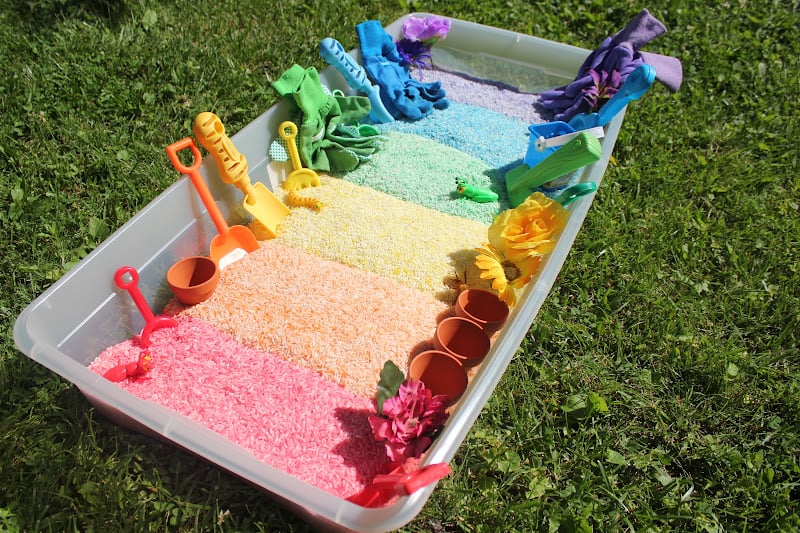
Rainbow Rice Garden Sensory Tub

Materials:

  • Uncooked rice
  • Food coloring
  • Rubbing alcohol
  • Tub
  • Gardening tools
  • Fake flowers

Directions:

  1. Measure out the rice (6 cups) and put it in a Ziploc bag with about 2 drops of food coloring and 2T of rubbing alcohol. (make red, orange, yellow, green, blue, and purple)
  2. Mix the rice in the bags to spread the color. Put them on pans to dry in the sun.
  3. Pour each color side by side in a sensory tub in the color of a rainbow.
  4. Add garden tools and gardening gloves and the fake flowers.

Rainbow Cookies

Ingredients:

  • Sugar cookie dough
  • food coloring (all the colors of the rainbow)

Directions:

  1. Divide dough into 6 portions. Tint each with a different food color (red, orange, yellow, green, blue, purple).
  2. Preheat oven to 350 degrees F
  3. Roll dough into strips and form your rainbows but pushing the colors together.
  4. Bake cookies for 8 minutes or until lightly browned. Cool and store in an airtight container.

Rainbow Collage

Materials:

  • Crayons
  • Cardstock
  • Felt
  • Paper
  • Feathers
  • Pom poms
  • Ribbon
  • Foam Pieces
  • Glue

Directions:

  1. Have the children pre-color-sort collage supplies.
  2. Draw and color a rainbow on a piece of cardstock.
  3. The children color matched an assortment of stickers, felt, paper, feathers, pom poms, ribbon, and foam pieces onto the rainbow.

More rainbow fun that we had this week:

Rainbows Day 1 -Colors

We spent the first day of our rainbow unit study learning the colors of the rainbow.  We had fun with baking, crafts, reading, science experiments, similes, and math.  The favorite activity for the kids today was definitely the rainbow flower cookies that we made.  The three older kids can now recite all the colors of the rainbow.

Colors of the Rainbow

Discuss: What are the colors in the rainbow? (ROY G. BIV) Red, Orange, Yellow, Green, Blue, Indigo, Purple. Newton added indigo and orange to give a total of 7 colors similar to the number of notes in a musical scale and number of days in a week. Indigo is not really a color. It is a shade between blue and violet. Many people omit indigo from the rainbow spectrum because it is not a color and is hard for the human eye to distinguish between the blue and violet.

Read: Liz Makes a Rainbow by Tracey West

Comprehension Questions:

  1. What are the colors of the rainbow? Red, Orange, Yellow, Green, Blue, Purple
  2. What is shade of color between blue and purple sometimes called? Indigo

Ordinal Numbers

Directions:

Give the child a blank rainbow and have him listen and follow the directions below as you read them.

Start at the top and color the first arc red.                    Color the fifth arc blue.

Color the fourth arc green.                                           Color the third arc yellow.

Color the second arc orange.                                      Color the sixth arc purple.


Rainbow Color Matching


Make a large rainbow out of poster board.  Place the rainbow on the floor with small items of each color in a basket.  The child places each item on the appropriate colored arc.

Rainbow Similes

Read: What Makes a Rainbow? by Betty Ann Schwartz

Discuss: A simile is a figure of speech consisting of a comparison of 2 objects using like or as. Similes tell you what something is LIKE. Similes are in What Makes a Rainbow? “Red LIKE a ladybugs wings.”

Materials:

  • Poster Board
  • Markers or Crayons
  • Printing Paper

Directions:

  1. Pick a color. Describe the color by answering the following…
  2. Tastes like
    Smells like
    Sounds like
    Looks like
    Hot like
    Cold like
  3. Tell in a sentence or group of sentences what this color looks like, sounds like, etc…
  4. Lightly sketch an outline of a large rainbow on the poster board.
  5. Write our poems in the stripes exactly how the children dictate it to you.
  1. Kids can make a smaller version of the Simile Rainbow on a piece of paper.
  2. Kids write the word color over and over for each arc in the rainbow.
IMG_0363

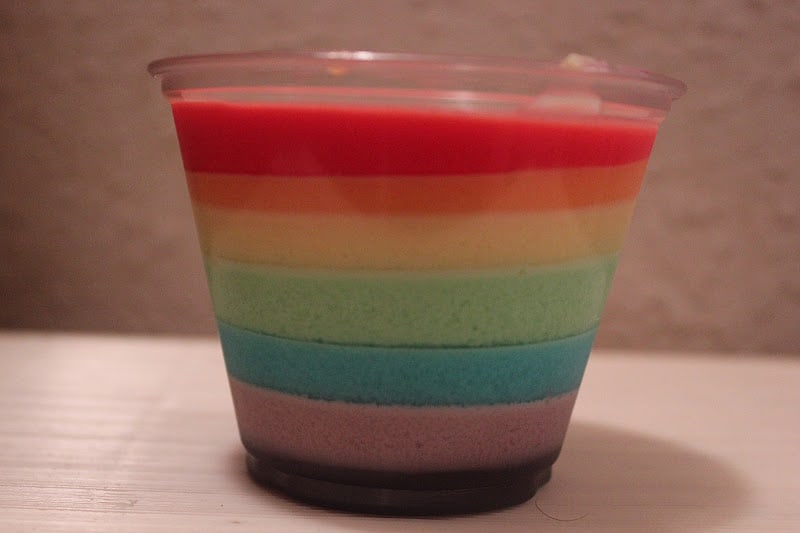
Rainbow Pudding Cups

Ingredients:

  • 6 packages of different colored Jello (purple, blue, green, yellow, orange, red.)
  • 6 Cups of Vanilla Ice Cream
  • 6 Cups of Hot Water.
  • Clear glasses
IMG_0329

Directions:

  1. Follow the instructions on the back of the jello box, but instead of adding a cup of cold water, you add a cup of ice cream.
  2. Make sure you pour the pudding in a clear glass, and let each layer set up in the refrigerator before you add the next layer.  
IMG_0330

Rainbow Puzzles


I print off page 8 of this Rainbow Download and let the children cut them out and place them together.

Cotton Ball Rainbow

Materials:

  • Cotton balls
  • White paper cut in a cloud “shape”
  • Construction paper in each color of the rainbow
  • Glue

Directions:

  1. Give child the cloud shape.
  2. Cover the bottom of the cloud with glue.
  3. Child places color paper at the bottom of the cloud.
  4. Add additional glue all over the paper cloud.
  5. Place cotton balls to add “fluff.”

Planting A Rainbow

Read: Planting a Rainbow by Lois Ehlert

Materials:

  • Sugar Cookie Dough
  • Food Coloring
  • Unsweetened cocoa powder
  • Sucker Sticks

Directions:

  1. Divide the dough into 7 parts (one for each color and one for the flower centers)
  2. Color the dough with the food coloring (red, orange, yellow, green blue, purple)
  3. Add a tablespoon of unsweetened cocoa powder to the dough, for the brown, flower centers.
  4. Roll the dough into 1/2 inch balls.
  5. Place colored balls around the centers, to form flowers, on a greased cookie sheet. Press them together a little, so they stick to each other. T thought he was playing with play dough!
  6. Add a sucker, pushing it through the dough into the center of the flower. 
  7. Bake as normal for sugar cookies (350 degrees Fahrenheit for 10-12 minutes).

Baking Soda & Vinegar

Discuss: When the baking soda and the vinegar mix they create an acid-base reaction and the two chemicals work together to create a gas (the bubbles).  Observe the 3 states of matter: the baking soda is the solid, the vinegar is the liquid, and the bubbles is the gas.

Materials:

  • baking soda
  • vinegar
  • spoons
  • clear cups or containers
  • food coloring
  • a tray to hold any spills

Directions:

  1. Add a few drops of food color to each spoon.
  2. Fill the rest of each spoon with baking soda.
  3. Add ¼ to ½ cup of vinegar to each cup.
  4. Choose a spoon and stir it into one cup of vinegar.

More rainbow fun that we had this week:

Christmas Sugar Cookies

We made Christmas sugar cookies for a family activity tonight.

Sugar Cookies

Ingredients:

  • 1 cup butter, softened
  • 1 ½ cup white sugar
  • 1 egg
  • 1 teaspoon vanilla extract
  • cups all-purpose flour
  • ½ teaspoon baking powder
  • ½ teaspoon baking soda

Directions:

  1. In a bowl cream butter and sugar until fluffy. Add egg and vanilla; beat until smooth.
  2. In a medium bowl combine flour, baking powder and baking soda. Add dry ingredients to the creamed mixture. Stir till soft dough forms.
  3. Refrigerate for 2 hours.
  4. Roll the dough on a floured surface.
  5. Use cookie cutters to cut out Christmas shapes.
  6. Grease a pan and place the shapes of dough on the pan.
  7. Preheat oven to 350 degrees F
  8. Bake cookies for 8 minutes or until lightly browned.

Buttercream Icing

Ingredients:

  • 1 cup butter
  • 1 cup Crisco
  • 4 cups powdered sugar (2 lbs)
  • 2 teaspoons vanilla
  • 1 tablespoon milk (if thick)

Directions:

  1. Cream together the butter and Crisco with a mixer.
  2. Slowly add in 1 cup of powdered sugar at a time.
  3. Add the vanilla, if it seems too thick you can add a bit of milk.